Sunday, July 2, 2017

Book Summary: Over-Diagnosis – Making People Sick In The Pursuit Of Health, by Dr. H Gilbert Welch

Imagine one morning you don’t feel right and go in WebMD (medical portal) to figure out what’s wrong, you browse around until you find the illness that catches your eye, Swine-Flu.

As you read through the list of symptoms you realize that you have all of them or in other words if you have all of the symptoms that you would have if you have Swine-Flu.  If we talk in term of probability, 95% of the people with swine-Flu have these symptoms. You began to freak-out and this is what happened to us most of the time. You search about any small symptom on the internet, you are sure to meet disaster. They will lead you to the any form of cancer or any dangerous disease. But this is not the truth sometimes, in fact, most of the times. Let us see how. If you know about Bayes Theorem, (a concept in probability. Don’t worry we are not dealing this in detail) you do further research and try to find out more facts to figure out the probability if you have swine flu or not. So, with little more googling you discover that the disease is extremely rare, only one in one hundred thousand (1/100000).Now, about the symptoms, like headache and runny nose, lots of people have those and google tell you one in a hundred (1/100). Putting everything into the place, now probability (using Bayesian theorem) of have Swine Flu is calculated as .00095, which is very-very small as compare to the probability we saw in first stance i.e. 95%. If we revisit the statement once again “…95% of the people with swine-Flu have these symptoms”, DOESN'T mean if you have these symptoms then 95% chances of you having Swine Flu.

In the book, Overdiagnosed: Making People Sick in the Pursuit of Health (Beacon Press), Welch and coauthors Lisa Schwartz and Steven Woloshin write about the hazards of looking too hard for illnesses in healthy people, including additional procedures that carry no benefit, but may cause harm, higher health care costs, and psychological detriments. “The biggest problem is that over diagnosis triggers over-treatment, and all of these treatments carry some harm,” says Dr. Welch.

There is an assumption that sooner is always better  but the hidden assumption states anything found early required intervention. OVER-DIAGNOSIS can be defined as the detection and treatment of an abnormality not destined to ever produce symptom or death.

This book is divided into twelve thorough chapters that do not only unveils the systematic conspiracy of the health care systems but also bursts the hypes created by popular media that promotes the fear of disease and perpetuates the myth that early and aggressive treatment is always better. Doctors have begun to leave no test undone, no abnormality overlooked. Profits are being made from screenings, medical procedure and pharmaceutical.

Chapter two; We change the Rules, highlights the clear traces of conspiracy at the institutional level. It shows how numbers get changed to give you diabetes, high cholesterol and osteoporosis. The author provides the end-to-end research to prove that over-diagnosis or early detection doesn’t help the population at large but only instills the fear of being died with the disease. Let us see how-
Who is diabetic? Before 19997, if you had fasting sugar over 140, then you had diabetes. But in 1997 the Expert Committee on the Diagnosis and Classification of Diabetes Mellitus redefines the disorder. Now if you have fasting blood sugar over 126, you have diabetes. So everyone between 126 and 140 used to be normal but now has diabetes. That little change turned over 1.6 million people into patients.

Is that a problem? Maybe, or May not be. Because the rule has been changed, doctors now have to treat more patients for diabetes. That MAY mean that they have lowered the chances of diabetic complications for some of these new patients. But because these people have milder diabetes, they are at relatively at low risk of these complications to begin with. The author has proved through the research that people with mild abnormal blood sugar have less to gain from treatment. If patients are not getting benefited from the early diagnosis then who is?

These changes substantially increased the market for treatment and the money to be made from them. There are widespread concerns about the independence of the experts who set the cutoffs for all the conditions (whether it is diabetes, hypertension, osteoporosis or any other disease). The head of the diabetes cutoff panel was a paid consultant to Aventis Pharmaceuticals, Bristo-Myers Squibb, Eli Litty, GlaxoSmithKline, Novartis, Merck and Pfizer – all of which make diabetes drugs. Nine of the eleven authors of recent high blood pressure guidelines had some kind of financial ties – as paid consultant, paid speaker, or grant – to drug companies that made high blood pressure drugs. Similarly, eight of the nine experts who lowered the cholesterol cutoff were paid consultants to drug companies making cholesterol drugs.

With over-diagnosis, a few may be helped but a lot more will be over treated and some of them will be harmed. The conventional ethos of medical is to focus of potential benefits for the few and to downplay the rest. Dr. Welch proved via randomized trials that the treatment on ‘new’ patients (with mild abnormality) does not improve the chances of not getting better. However, over diagnosis will increases the chances of plethora of other diseases.

In the graph on the left (fig. 1a), the rise in cancer diagnosis is accompanied by a rise in the feared outcome of cancer -  death. This suggests that the new diagnoses are destined to be meaningful and that this is a true increase in the underlying amount of cancer that matters.


But in the graph on the right, the rise in cancer diagnoses is not accompanied by a rise in cancer death. This suggest that while there is more diagnosis, there is no change in the underlying amount of cancer that matters.

Over-Diagnosis can also be understood as an attempt to look harder to find the abnormalities without any symptoms. This has been seen in cases of prostate cancer, breast cancer and other abnormalities which required scanning. Fear has taken place of understanding the disease. The simple rule of thumb that can be deduced from the findings of the author is that -  diagnosis is important but it should follow the symptoms not the other way around.

Author cautions in the end that it’s tempting to conclude that the solution is simply to avoid doctors. But that would be the wrong conclusion. Medical care offers ill patients a great care. The question is about when you are well. How hard doctors look for things to be wrong?

Tuesday, April 4, 2017

Book Review: ‘I am a Troll: Inside the Secret World of the BJP’s Digital Army’ by Swati Chaturvedi

The name of this book made me understand more about the term ‘Troll’.  A message that someone leaves on the internet that is intended to annoy people is troll. Lacking logic and perhaps even decency, these most often nameless, faceless but sometimes wholly visible people attack those they don’t agree with.

I am a Troll: Inside the Secret World of the BJP’s Digital Army is Swati Chaturvedi’s two year research. Her investigation as she calls it, is ‘inspired’ by her own experiences and those of her ‘fellow citizens’ who have been on the wrong side of trolling.

When any writer writes against the political party (BJP), which is not only ruling the country but came into power with huge majority and continuously spreading its presence in whole country, then, for sure, the writer is very courageous.

The veteran journalist, in this quick-read, maps out how some of the most venomous handles on Twitter are those that are ‘“Blessed to be followed by PM Modi”. The PM follows them, they follow him, and they also follow those who speak against him – attacking them at any given opportunity in what looks like a fully organised, coordinated game plan.  Through her conversations with BJP social media volunteers and Sadhavi Khosla (a former BJP social media cell member), the author takes us through how social media attacks are planned.

It reveals the BJP’s strong social media cell and its vast online support. Sadhavi Khosla claims that the BJP’s media cell pressurize the Snapdeal to drop Amir Khan is its brand ambassador after Amir’s strong comments about intolerance in 2015. Another undercover story states that the same unit trolled Shahrukh Khan and provoke its online support to boycott his movie Dilwale.
Ms Charurvedi alleges BJP for carrying out organized trolling on social media platforms to conveys a sense of the mood to the masses.

In her telling, the Bharatiya Janata Party (or the larger Sangh Parivar) uses volunteers and paid employees to function in concert and to execute centralised directives to “constantly peddle hate tweets and conspiracy theories and slander journalists”. Worse still, she claims, the hate-filled tweets are packed with communally volatile misinformation (a mythical exodus of Hindus from Kairana in UP, for instance) and contain threats: Hire so-and-so and we will boycott your company/paper/channel/product or  even worse.

Mr. Modi is followed some cyber bullies Twitter accounts (like LutynInsider, which I could not find on twitter. May be it got deleted after the row) that regularly tweet abusive language or obscenities, she claims. On the same note, Derek O’ Briain raised Ms Chaturvedi’s claims in the legislature, questioning why Mr Modi followed cyber-bullies.

Ankit Lal from AAP, who Chaturvedi says “tracks the ruling party’s social media as part of his work”, presents information on the same, casting doubts about how either the “BJP social media control centres have started using virtual private networks (VPNs) to hide their location and identity… The other possible explanation is that the BJP has hired a marketing agency in Thailand to do their online work.”

Moreover, this books gives the impression that BJP is the only single party that is using social media power to influence the behavior of the people which doesn’t seems a balanced view.  Other parties and people are let go scot-free, even when we know that everyone plays a dirty game – on Twitter and off it.


Huffington post  calls this book as a missed opportunity as of the seven short chapters that make up Swati Chaturvedi's work, almost entirely devoted to the testimony of Sadhavi Khosla, a former volunteer with the Bharatiya Janata Party (BJP), who has been responsible for the most explosive revelation in the book.  ‘While her mission to expose these trolls -- an army of men and women who thrive on misogyny, Islamophobia, hatred and bigotry -- is incredibly brave, urgent and necessary, the execution of the project could have been much better.’

On the factual front, I found little inconsistency in the facts; One, it was told I the book the flesh from the Akhlak’s home was not beef, which is incorrect. It was confirmed I the reports that the meat was found to be beef. Secondly, the picture is not black and white when she claims that Sadhavi Khosla  is the former volunteer with BJP as BJP denies the claim. Thirdly, with certainty, she says, Mr. Modi is handing its twitter accounts. It is very hard (but not certain) that the PM is so attached to his twitter account when he handles this by himself.

This book is less about trolls in general and more about what she claims is “the BJP’s digital army”. Chaturvedi has taken an interesting look at a topic of growing relevance to India and other democracies but should be researched without bias.


Saturday, July 30, 2016

Winning Teams


The complex organization structure is the composition of small entities called ‘Teams’.  An organization’s success is directly related to the effectiveness of these teams. These team make up the culture of the organization and their health is the reflection of the organization’s culture health. To realize the high performance results, we have to understand the heath of the team to make it highly collaborative. Winning teams come out from the winning culture. The culture of the team emerges out from the individual’s contribution to the culture.

Collective high morale of the team is the greatest contributor to the habits of winning. Any team can’t think of wining without the collective readiness for the winning. Creating great teamwork is a challenging process. Referring to a collection of people as a team doesn’t make any team winning. A group is typically a collection of people who are collected headed by the leader where member works on their own most of the time with little or no dependence on other member of the group. But the team shares the leadership, people in the team are interdependent, they have collective sense of responsibility not just ‘My Work or Your Work’. The goal of the team is more prominent than their individual goals. Individualism is the prime character of a group whereas a team plays on collaborations.

It is easier to decide on change than to get people to change. People and teams are creature of habits and changing habits are much harder than changing structures and systems. Whose responsibility is it to create a good team; the leader or individuals? A leader is seen as the owner a team but in this age of quick and exhaustive information, leaders can’t only be considered as the full source of information to lead the team. Though, there is a leader of each team but situational leadership is required where each individual has to lead in different situations.

Positive team spirit and sportsmanship attitude are required. A robust culture is the result of nurturing individual and team spirit. There are numerous absolutes of team building but a few are indispensable, they not only build the team spirit but also integrate the individuals to pursue for a common goal. Some of the TeamSpiritBuilders are as follows.

TeamSpiritBuilder #1,  Seamless Communication

Communication is the blood of any team, it carries the information and ideas to be shared with the team. Communication is not limited to mastering any language and usage of contemporary phrases and expressions, it is an intention to let your ideas flow. Good communication is all about inner readiness to share what you think. The main objective of communication to put everyone of same page. Honest and transparent mind-set allows good communication to happen. Aim toward two-way interaction, exchange of ideas, and developing new insights in regular communication.

TeamSpiritBuilder #2, Togetherness

All corporations, big or small, are running many events in their organizations to promote inclusion at all levels. It main objective is ‘Togetherness’. When people come together in an informal arena their bonding grows, their understanding about each other grows, truth strengthens and stress bursts. Create times for people to laugh together and loosen up. This will also stimulate creativity. Consider some of these ideas: start a meeting with a relevant joke or funny story, show a clip of a comedy video tape that pertains to a current challenge. But, on the other side when people do not participate with their wish and are forced to participate, it works in other direction. This has to be ‘Very Intentional’. But what if individuals are not ready to come for these activities? then we are picking the wrong chord first. We need to fix another chord.

TeamSpiritBuilder #3, Empower for Ownership

Ownership provides confidence among individuals. Control-obsessed culture often broods escapism. Giving ownership does not means throwing the responsibilities to the individuals but it should be supplemented by resources. Encourage opinions on important decisions affecting the business. Give a voice to each individual so that everyone shares the context that they are able to contribute to the success of the team. When people feel like they’re being heard, it will go a long way toward enriching relationships, fostering collaboration, and heightening engagement.  No team can grow when people are afraid of taking the responsibility.

TeamSpiritBuilder #4, Higher Mood State

The mood elevator; the higher mood state or lower mood state determines the morale of the team. The higher mood states are; curious, flexible, sense of humour, understanding, appreciative, optimistic resourceful, creative, insightful and grateful. On the other hand, the lower mood states are; impatient, irritated, worried, defensive, judgmental, burned-out, angry and depressed. The feelings on mood elevator are nothing more than product of our thinking. Inability to cope up with stress leads to lower mood states. Stressed team cannot be a winner team. The leader should have a sense to measure the stress of the team and take steps to de-stress the team. This should be the first step in the journey to be a great team. In an atmosphere of high expectation from the customer it is next to impossible to stop the stress from the source but individuals should be made capable of managing the stress. And this has to be taught. How? This can’t be done by repeatedly saying that ‘ you should learn stress management’ but provide training to fight the situating. They should learn how to prioritize, how to organize, how to seek help and most importantly, how to negotiate. Healthy state of mind creates healthy culture.

TeamSpiritBuilder #5, Trust

Trust is the foundation of healthy team and trust builds in an environment of transparency. Trust helps in accepting deepening relationships and removes politics and silos from the work place, creating an organization within which people feel safe. A team without trust isn't really a team; they may not share information, they might battle over rights and responsibilities, and they may not cooperate with one another. It doesn't matter how capable or talented people are, they may never reach their full potential if trust isn't present in the culture of the team.  How to build trust? Trust can’t be built by preaching about trust, that many organization does. Open communication is essential for building trust. Everyone in the team should be talking to one another in an honest, meaningful way. And that can be done when everybody is clear about what he/she is doing and how it is contributing to the common goal. Know each other by meet regularly, share personal stories or experiences and respect differences.

TeamSpiritBuilder #6, Learning, not just preaching

Fast changing dynamics of businesses requires people to learn things quickly and implement them into the job. The success of the team largely depends on how responsive the team is towards change and readiness to learn. Leaders who only inflicts fear find it difficult to motivate the team. Leader are facing a lot of problems when they assume people should understand by themselves. Even the smallest issue may require training. Training is about learning the new way of doing any job. Corporate trainings are of two types; technical trainings and soft-skills trainings. It is easy to get the people work on any new tool but often difficulty to convince that their email response time is more than expected. Simplify the process.  Don’t exhaust employees through complexity and buzz-words.  People seek direction that is too the point. People are inspired when given the opportunity to learn how to do new things.

TeamSpiritBuilder #7, Encourage Networking

Ability to network with people outside the team means to expand our orbit of resources. Not a single process or skill can be excelled in isolation, we are required to work in collaborations. To be comfortable among ‘not friends’ forces you to learn a lot of new social skills. Networking is about people enjoying other people, communicating passions and connecting with others who share those passions. It’s about listening, figuring out what others need and connecting them with people you think can help, without any designs for personal gain. Each team members should understand the need of healthy networking.

TeamSpiritBuilder #8, Measure performance

You can’t improve what you can’t measure. Prepare team profile on the basis of above seven TeamSpiritBuilders and rate your team from 1-10. Set realistic goals weeks by weeks. Prioritize needs. Focus, where you require more development for ex. if your team is poor in communicating ideas then it should be given top priority. Communicate the performance result to the team and ask their suggestions for improvement for the next cycle. Involve team in goal-setting and planning. Two-way communication get the individuals connect with the requirement.

Winning culture creates winning teams. Culture is defined and created from the top down, but it comes to life from the bottom up. You really can’t change the culture without changing the behaviour of the individuals in that culture.

Friday, April 8, 2016

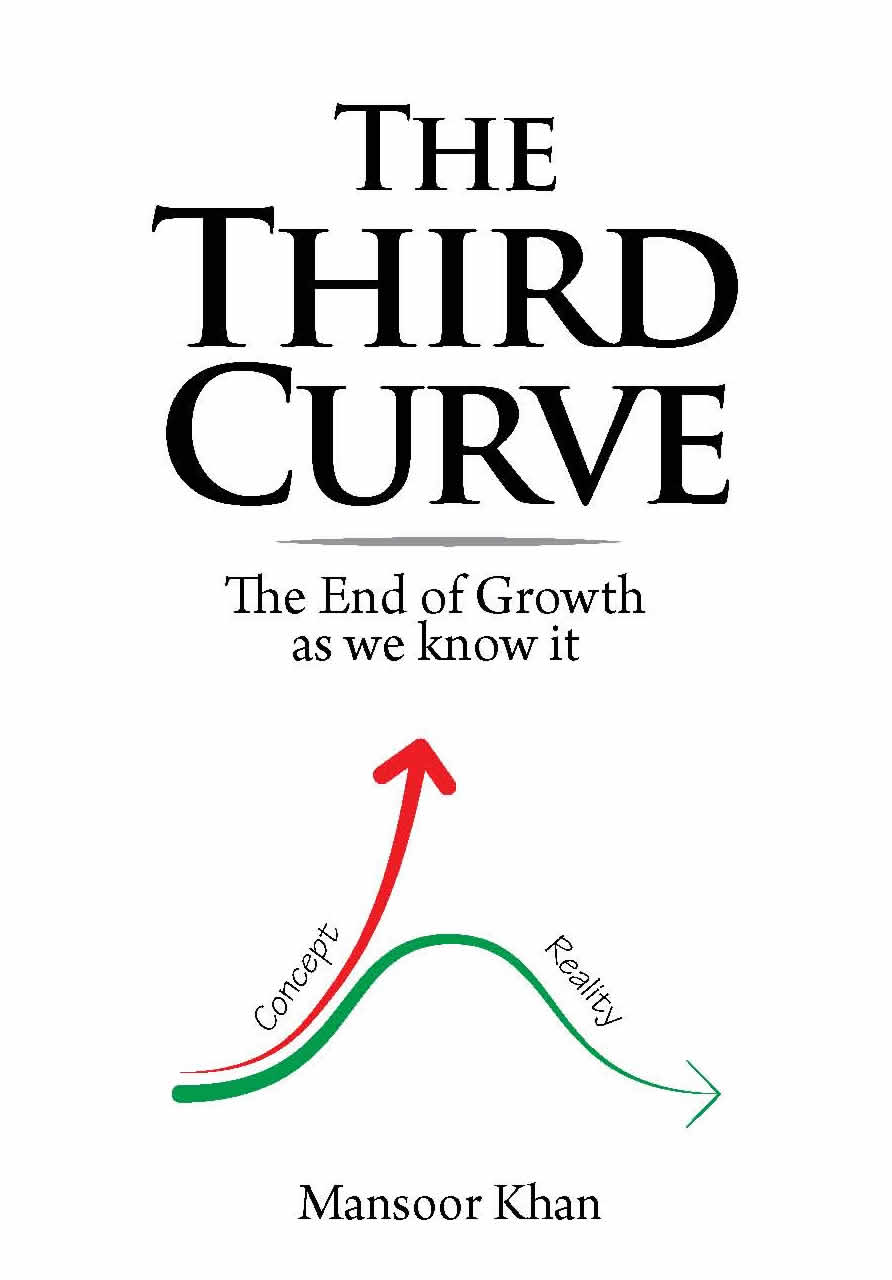
Book Revew: “The Third Curve” – by Mansoor Khan

If you are below 40 years of age then you are likely to face this monstrous problem in your lifetime. If not, no less than certainty our children will surely see the day-with-no-oil.

Daily, we hear thousands of statements about this phenomenon called ‘Growth’. We are now conditioned to believe that growth is a natural reaction of society. When growth becomes our religion, we choose governments, ideas and all notions that support the concept of ‘never-ending growth' then the author shakes our consciousness to portray the sustainability of the concept.
If ‘never-ending-growth’ concept is seen as sustainable the question arises, for how long? Mr Mansoor Khan has tried to provide us the lens to understand the inversion of economic reality. It identifies the root cause of the malady by reminding us of forgotten relationships between money and energy, capital and resources and reality.

Though ‘Oil-Peak’ has been discussed here with great extent but the foundation of this book is laid on the ‘Unsustainable-Concept’ of exponential growth with exhausting natural resources. In spite of using heavy graphs and big numbers, Mr Khan, very aptly used an analogy to understand and realize the depth of the problem.

Part-1 states the story of ‘The Coach and the Runner’. The coach has a concept which he claims can make you the runner, run at the speed of sound in just 18 months.
‘How is that possible’, you wonder.
He explains, ‘Can you run at 10km/hr?”
‘Yes, of course, that is slightly faster than walking’.
The logic game goes further. ‘Then you can run 7% faster at 10.7 km/hr, right?’
‘Sure’, you agree.
‘After three weeks, you can run 7% faster at 12.25 km/hr?’
‘Sure’.

The coach promises that you can run 7% faster than last week every week. In this way, it will take 18 months to break the spead of sound. Awesome!

The coach approached the sponsors and display encouraging charts, supported by descent logic. Picture is rosy so sponsors are ready to pay money and training starts. In phase 1, you ran 7% faster, sponsors are happy, and all is going well as per the plan.

In phase 2, you fail to run faster at same growth then your coach puts you on steroids and you are able to run little faster, say 3% or 4%. Bur in phase 3, you collapse.

Here comes the explanations of the first two curves; the first curve is the exponential curve, that is desired speed (goes to infinity) and second curve is bell-shaped curve which is actual speed (body). The concept (mind and desires) i.e exponential curve goes to infinity, the same way we think about economic growth. We are convinced that our current concept of infinite economic growth will keep the growth as it is. The reality (body and resources) can be seen in bell-shaped curve which has start, rise, peak, downfall and end. All natural resources including oil follow the bell-shaped curve; we started using, increased production, reaches peak, slow down production and finally finishes.


 Our demands from the nature follows the exponential curve, isn’t it?. Can we afford to live without the idea of growth? A big question for all of us.

We are positive people, sorry extremely positive people filled with creativity so we find the alternatives, we think. ‘Oil Peak’ has always been the burning issue since early 90's but the truth of the matter is oil production follow bell-shaped curve. Ever if the peak is shifted, the decline is inevitable. Many of us or our children will face the consequences of oil-depletion.

‘The third Curve’ nicely explains the fragile financial system which sits on the idea of greed and desire of ever-increasing economic growth. When historic money data is blended with oil data then it clearly shows the exponential curve of money that all the governments are producing. The historic oil data follows the half bell-shaped curve. Experts say that we are at the Oil Peak and oil will be produced lesser and lesser in the coming future.

Just because to protect this economic growth the current human generation has compromised everything; Natural Capital (natural resources), Ecological Capital (forests, rivers and animal kingdom), Social Capital (bond of family), Cultural Capital, Spiritual Capital (honesty, trust and peace).

The third part of book check the sustainability of the alternative sources of energy. Here alternative sources are seen as ‘A Mirage of Hope’ which is elaborately explained with graphs and ideas. All alternative sources (like wind, solar or nuclear) and ideas (like technological advancement and energy conservation) have to be viewed in the perspective that it is going to replace the oil, which is the backbone of the current economic model. Alternates have to be very strong to take that place, merely presenting the rosy picture of alternate ideas in some conferences do not serve the purpose.

For the same, the author tested all the ‘Hot Alternatives’ on five technical parameters which are called Energy Rules. These are; Rule #1 Net Energy, Rule #2 Oil Dependency, Rule #3 Energy Density, Rule #4 Scalability and Rule #5 Oil-by-Product.

Unfortunately none of the alternative sources passed the test to replace oil. Let us understand with an example, if we take Wind Energy, it fails Rule#2,4 and 5. Wind energy is intermittent, low density, expensive, oil dependent, has limits of scalability and generates only electricity. It is sorely dependent on Government subsidies for viability. It can never keep the Modern Industrial World running the way it is on oil. Same is with Nuclear energy, it fails Rule# 2 and 5.

There is no escape unless we change the concept of growth. This has been explained in the fourth part of the book which is ‘The Third Curve’. The third curve is called ‘The Eternal Rhythm of the Universe’. It synchronizes with the nature and its resources. It is not a question of how much energy we can find and burn in an illusion of success and progress, but is a question of how much we should.

The third curve of a living earth faithfully follows the rhythm of our primary energy provider, the Sun. Reliably it rises, peaks and ebbs only to rise again. Nothing going to the sky and nothing going to the zero. We are reluctant to accept the truth, the author says that we have two paths; denial or acceptance of Peak Oil.

The part through denial can certainly extend our moment at the top but a chaotic collapse is certain. The path through acceptance can immediately start a soother, longer and managed energy descent, which involves re-alignment of our economic paradigm.

Last and fifth part of the book focuses on ‘Rebuilding a post oil world’. In this modern industrial civilization, the collective belief so far has been ‘big is beautiful, more is good, individualism is prime etc.’ All this led to a particular kind of social structure and lifestyle.

Author urges that we now have to believe personally that ‘small is beautiful, less is good, local is important, community is strength and diversity is paramount.’ This amounts to a huge shift in our cultural perspective. Not easy but then we are not talking about ease, we are talking about what is likely to work in an energy declining world.

The book is very inspiring and captivating. You can certainly digest the heavy stuff with ease as author left no stone unturned to keep its presentation precise. Coloured graphs, clear diagrams and good quality pictures are augmenting the effect of the high quality research work of Mansoor Khan.

By the way, Mansoor Khan is an alumni of IIT Madras, Cornell University, and MIT, Boston. He started his career as film-maker and made his directorial debut with Hindi film ‘Qayamat Se Qayamat Tak’ in 1988. His other famous films are ‘Jo Jeeta Wahi Sikandar’, ‘Josh’ and ‘Akale Hum Akele Tum’. Hope you will enjoy reading this book.

Key Words: False Money, Pseudo-Assets, Financial Jugglary and Proliferation effect.

Friday, January 22, 2016

My 10-days in Vipassana Meditation Center

We do claim to know many things, in fact everything, in our life. Though, we know a lot many things we do not realize them. For example, you can hear an advice on ‘how to invest in stocks’ form the one who never invested a penny in stock market. Our most problems starts when we convince ourselves that we know but in reality we don’t know, we never realize. One such thing is meditation. There comes a time in everybody’s life when we want to move forward from knowing and understanding to experiencing and realizing. ‘Focused-mind can solve your problems of life and you can focus your mind through meditation’, I learned from many masters in their fields. Motivated by some you-tube guided meditation techniques, I decided to learn this art from Vipassana Meditation Center, which is also called ‘Dhamma Khetta’. Best things in this world are free or at very less cost. You can register online and ten days stay is absolutely free including food.

On the way to the center, I asked an old uncle the way to Dhamma Center, he guided by giving directions and said ‘You are going to a great place and All The Best’. Great place I am going, I knew that but why he said ‘All the Best’. Did not bother. Reached the place, after registration, all are supposed to be interviewed by the teacher. He asked me some simple questions like what I do, medical history and all. ‘Do you have the will power to stay here for ten days’ he continued asking. ‘Of course’, I said. ‘I came here after taking ten days leave from my company; I dedicated these days to meditate to live a peaceful life’, I thought. ‘All the best’, said the teacher and I move to my 8 feet by 10 feet room which I had to share with one person.

Life-At-Halt

It was as your life was moving like high-speed train suddenly stopped at rest. There were certain rules we had to follow. You are not allowed to bring you phones, tabs, laptops, reading or writing material with you in the room. You have to stay inside the boundaries where it is written ‘practitioners are not allowed to move out of this boundary’. You cannot speak with anyone, only on a rare occasion you can speak with the supporting staff, called ‘Sevaks’. No hand shakings, no greetings and you cannot look into anybody’s eyes. They do all this to maintain ‘Arya Maun’, which means ‘complete silence’; outside and inside environment.

They serve breakfast at 6:30AM, lunch at 11:30AM and guess what would be the timings for the dinner. There will be no dinner. Only evening tea with pop-corns will be served at 5:00PM.

Sudden restrictions on the way I was living created a feeling of anxiety. The statement ‘All the best’ flashed in my mind. This was the first realization. On the name of freedom we become too dependent on the amenities of life. The way we discuss peace and meditation in cozy environment is very different from the reality.

All Is In The Mind

Doors are closed now, I can’t go outside, can’t share anything with anyone, can’t read or write. It was first day and my mind was clouded with all the negative thoughts. ‘What will happen if I fell ill, will they provide medicine, how can I live without dinner, food is the basic necessity, they should provide dinner, how will my family members contact with me if they have any problem, Oh my god! my interview call is scheduled next week and I did not intimate them…’.

Suddenly we were called for evening tea. I walked fast to be first in the queue to get my share. As it was first day they decided to provide Upma which made me very happy. I ate double the quantity I normally eat as there would not be any dinner. Many times our body compensates for the stupid and anxious thought of our mind, so did my body. I had stomach upset that whole night.

We got the schedule for the following days where we need to meditate for ten hours per day for next nine days without fail. I need to get up 4 o’clock in the morning, meditate in different stretches whole day until 9 o’clock in the night.

With stomach upset and anxious feeling, I thought if I did mistake coming here? I could bear many things but ‘no-dinner’ was highly un-nerving thought which I never practiced earlier. I had no option but to go with this.

On day 2, there was only tea and pop-corn in the evening but I did not eat much taking experience from the previous day. That night was relaxing. On day 3, eating food in small quantity was normal to me. I had no anxiety of not getting anything to eat at night. That was second realization, ‘Everything is in the mind’. The same ‘me’ two days back was feeling all the troubles of the world and the same ‘me’ in same conditions is calm now. Not sure what worked on me but I felt, when all doors of alternatives are closed and you have only one option, your mind will get convinced; you become peaceful.

Adhishtana – The Practice to Increase Will-Power

All are required to meditate for 10-hours per day but my favourite practice session was ‘Adhisthana’ , the practice to increase will power. You need to sit in a position, without any movement, for an-hour. Though you can sit for some-time without movement but when you are told that you have to sit still, your mind starts to struggle against your will. Even 15-minutes of a sitting becomes difficult. Our mind does not want to be controlled; it revolts when you ask him to work as per your will. Enormous back pain, stopped blood circulation, itching everywhere in body, headache etc. are some of the symptoms of inner revolt. That was most difficult exercise throughout the course.
 
But you have no option, your teacher is observing, you have to sit. All mental revolts come to an end when we persist with single objective of the mind. There I realized the importance of teacher. If you have somebody to teach and observe your activities you can master anything.

Everyone was able to perform this activity by the end of course. It would not have been possible if there was no teacher to observe. Forced-discipline is required for sufficient time before the mind is ready to be ‘self-disciplined’.

My Pajamas was missing

A funny and very insightful incidence happened on the fifth day. If you are not washing your clothes by yourself you can give it to washer man who returns them on the following day. But that morning I could not find my pajamas at the place where we are supposed to get our clothes. There was no one to ask. I searched it everywhere but could not find. I was angry. ‘How can they do this, this is irresponsibility from their part, they should have told to bring one extra pair… blah..blah..blah..’. My mind was constructing thoughts at the highest speed possible. All inner-silence is gone now. The most urgent task for my mind was to get my pajamas and find someone who I can make responsible for this missing.

After an hour of effort, I moved a step back and asked myself ‘has this been so important that took all my peace’. Many times we give all our mental energy to the least important thing in our life. The more you try to forget the more it comes back. That is the favourite play of mind, ‘brooding the disturbing thought’. And the solution is ‘to observe’. The thought ‘my pajamas is missing’ kept coming whole that day but I started observing rather that reacting. I kept asking myself ‘Pajamas or Peace’. The thought became feeble at night. It was a day of great learning and realization. How deeply we are attached with petty thing in our life and we are ready to give all our energy to get them.

The Last Day

We were allowed to speak on the tenth day. There were people from all walks of life; students, bureaucrats, professionals, executives, entrepreneurs etc. Also, I found there were a few people who quit during the course, not sure why. I cannot explain their teachings and philosophy but I can say that I learned some hard lessons which would not have been possible in normal course of life.

Friday, November 13, 2015

Joined New Organization? Some Dos and Don’ts

The dynamic corporate world reduced the average staying period of an employee in any organization. According to US Bureau of Labor Statistics, the median number of years that an employee had been with their current employer was 4.7 years in 2014. People need to switch companies, industries, profiles due to a number of reasons. Dissatisfaction in current role (due to “NOT GOOD” manager or politics in the team etc.), lesser growth opportunities in present organization, better available profiles and compensation are most common professional reasons.

For a period of a month or two, the time is very crucial for every new joiner in the organization. It can be very stressful if not properly managed. You saw all ‘the greens’ in this organization while accepting the offer letter but now you may see it’s not that green. You can learn to adapt to an unfamiliar work culture. Every action or move you make has a consequence, especially when you are new. You can follow some dos and don’ts to make a smooth transitioning.

Do: Create support system

Initial few days are very important to lay the foundation of getting the things done you need. You need to understand how to get help from HR, IT, Operation, transport and see how it works. How much time they usually take to resolve any issue. May be, your previous company’s HR or IT are more responsive than the current one. You need to observe and understand rather than to frustrate and making a lot of escalation. If you don’t understand the support system of the company, it will take a lot of energy to struggle with them all.

Do: Accept change and try to understand the culture

You expect a lot of good things in the new organization, in fact all the good things, but you may get many surprises. People are usually averse to change. Some don’t even want to change their desk. Each company has its own culture; some are conservative while others may be open. You can approach senior leaders directly in some organizations whereas other may follow strict hierarchical structure to approach leaders. You need to modulate your current working style as per the new requirements. Accept change and understand the values and culture by ‘Observation’ and avoiding reactions.

Don’t: Haste in understanding the business

Never haste in understanding the business, especially with the big organization. Take time to understand the flow of business. Concentrate on your specific deliverables first, later relate it with the business. People join, try to swallow everything all of a sudden, fail and quit, and finally satisfied with their due tasks. It’s most important to understand thoroughly the business, the model of operations, your department connection with overall model and how your process connects with the departmental goals. More importantly, how products, services, projects and programs are translated into data. And this does take time.  Due to the complexities of the processes, everything is not documented in most of the organization. You should not surprise when you find things are much unorganized as this is the nature of the dynamic business. One high level movement can change the whole strategy. I do remember when it happened in one of my organizations. Consequently, everything has to change. Keeping the track and documentation of everything is the greatest challenge of every manager. Old SOP (Standard Operating Procedure) documents hardly serve the purpose for the new comer. So, BE PATIENT AND CONSISTENT in the process of understanding working model.

Do: Networking

Create rich and wide network within and outside your department. Go and meet the people, don’t wait for the people to come and greet you. Have casual conversations with them. In time, you’ll see who’s trustworthy enough for you to share more about yourself, your strategies and your future plans. Be friendly and polite to everyone. People inside the company can tell you a lot about the company that you will not find on your intranet portals. People are living SOP’s, they know better than you do, they can guide you how things work here, how to approach leaders if require. Join at least one company’s social group that will help you in embracing the culture.

Don’t: Go with the perception of the people

Though networking is very important, you have to be very cautious while listening to the people about the company. On the second day of my joining in one of the big multinational, a highly dissatisfied person asked me why I joined this company. He saw no growth but poor working environment around, which was incorrect. Refrain from joining the rumour-monger crew before you become a victim yourself. They try to teach you what they believe about the leaders, departments, culture and growth opportunities. You have no option but to listen everything during your initial days, though you can filter out the good advises later on.

Don’t: Brag about your old company.

One of my old colleague used to say “… you know, this never happened in my 5.4 years of experience in last company”. Grass is always greener on other side.  Avoid unfair comparisons. That may be a big obstruction while networking with the people.

You can manage if you plan. Keep an open mind and avoid being judgmental. When you are new to the job, people have the tendency to judge you based on the kind of behaviors you show at the initial stage. Reflect what you are, what you like and what you dislike. Few initial proactive steps can ensure the smooth ride where you can avoid a lot of energy-loss that is most important to bring the innovation and creativity into the work.

Saturday, August 22, 2015

Micro-Management Kills


Micro-Management is the signal saying 'you are incapable of holding the responsibilities so we kept you held accountable for what you do'. It kills innovation. Innovation, which is the key to creep-out from competition. Control-obsessed managers ruin their colleagues' confidence, hurt their performance, and frustrate them to the point where they quit. Respecting individual’s thoughts are pre-requisite of inclusion and independence.

When companies proudly says their professional are extremely talented, it’s better to believe in their talent. Professionals need to know what to do, NOT how to do. Under micro management, often professional become diffident, mechanical, unmotivated and possibly ever paralysed. Let the people do what they are hired for. Effective managers don’t hire people who are cloned to themselves. They hire people who are supplement to their skills to enhance the quality of deliverables.

Varied numbers of situations where micro management is preferred ranges from managers’ controlling mindset to employer’s inefficiency. The gap need to be filled between the managers of high experience and resources with relatively low experience. Trust your employees and provide them resources required to do their jobs quickly and efficiently.

A new manager received a challenging task from the top management where deliverables needed to be sent to leadership. This task was once failed from one of the professional who worked independently on this project. So providing freedom to another professional was a matter of great risk. This manager analysed the causes of failure. Though, the professional was skilful and motivated there were lack of clear goals, improper communication with management and ineffective interaction with the other stakeholders of the deliverable. Had it been micro managed the project would be successful? No! If it had been controlled by the delivery manager, who is incapable of understanding the technicalities of the project, the professional won’t be able to stretch his skills. So controlled environment was not the answer however focus was required.

With a handful of key notes and few results, the manager decided run the project through a professional who is capable of delivering the project with required quality. The goals were set clearly with the feasible timelines after open discussion with the professional. The project was started and it was the time to encourage the employee. How this can be done? Open talk? Visiting his/her desk often? NO. Listen and encourage opinions. Opinions may not be correct but direct rejection may obstruct the flow of creativity of the employee. Employees are closest to a lot of the work being done, so carefully consider their suggestions about how to run things. Ask question positively. This will ensure the feeling of trust which is the best way to build healthier relationship.

Second step the manager applied was to provide the necessary Resources required for the completion of the project. Third and last tool was Transparency and Inclusion, NOT just communication. Transparency is required to understand the big picture of the department or organization at large. Help the employee to understand this big picture. The idea is, there should not be more than one versions of requirements from the stakeholders and what is shared with employee. It’s only inspire inclusion but also it will induce the sense of responsibility in the employees. Pushing employees to the activities in which they are not good at, is not a good strategy of inclusion. But empower them in something they are good at, is true inclusion.

Motivated employee and visionary manager can deliver any project on time with superior quality, so did the above duo. When micro-management is the answer to any question better rephrase the question.

Tuesday, May 5, 2015

Book Review: PROFILE OF THE PERFECT PERSON: Based on The Bhagavad Gita Chapter II


Author: JAYA ROW
Publisher: JAICO

In an attempt to achieve excellence in all spheres of life we rely on religious or spiritual scriptures which are based on undeniable natural truths. The Bhagavad Gita is more about the proven guidelines to live successfully and happily in modern world than a religious text. “PROFILE OF THE PERFECT PERSON” explores verses 56 to verses 72 of Chapter II which outlines the basis of a perfect person.  Smt. Jaya Row, a commentator of Vedic philosophy, demystifies the versus in common language with perfect analogy and examples.

The Author asks why we are so bored with everything around us. It is because the essential ingredient is missing from our life. Bhagavad Gita is the most important ingredient of life, SALT OF LIFE. Trying to live without Gita teachings is like eating food without salt. The world today is like an enormous ocean with daunting waves. If we wait for the waves to subside we will be waiting forever. Instead we learn to surf them, the experience become enjoyable. In fact the more formidable the waves, the greater the thrill! We need to master the technique of riding the challenges, the world throws at us instead of buckling under pressure. And the first step is knowing ourselves.

Our personality is composed of four entities. The body is our outer layer which receives stimuli from the world and responds to them by way of actions. The mind is the home of emotions and feelings it generates love and hate, creates whims and fancies and function on impulses. Third parts is intellect, which differentiates between pairs of opposites (good or bad, correct or incorrect), it is the abode of rationality, analysis and judgement. Spirit is the fourth entity, referred to as Atman – is your true self. It breathes life into lifeless body, mind and intellect.


The mind is just a flow of thoughts that grabs at instant joy. It is incapable of discerning what is in our long-term interest and what is not. It is the intellect that can set aside the lure of immediate joys and guide us to deferred gratification.


Bhagavad Gita is about tapping the full potential of human being and the source of unlimited happiness. This book elaborates the happiness at 4 levels. Physical level or body level happiness can be achieved by sense-gratification. Our senses (eye, ear, tongue, nose and touch) are attached with their desires and we spend our whole life in satisfying our senses. Are we happy by the satisfying our senses? It is momentary, it is a trap and lowest level of existence. Second level of happiness, which is above the physical level, is emotional level. We have no worth of physical pleasure when we pursue emotional happiness. Strong emotional reasons overpowers the physical conditions. Many sportsmen have proven this in different arenas where emotions played a vital role. Intellectual level drive is the one level above emotional level. If you are driven by an intellectual idea you have access to far greater reserve of energy and vitality than you ever imagined.

The last and highest level of satisfaction is spirit level, the state of realization. When you can touch or access the innermost source then there is no desire left, everything is infinite at this stage.  This is the highest goal of every human being. Moving above the level is the gradual and systematic process which is governed by Yoga.

Chapter II of Bhagavad Gita explains the highest level of perfection in human being. The perfect person is said to be ‘sthitaprajana’ means ‘one established in wisdom’. In Verses 56-59, Lord Krishna expounds on the definition with greater descriptive clarity. Verse 60 is about how the powerful senses attack the mind and lead it astray. In verses 61 to 66 Krishna gives the pivotal role of the intellect. In 67 it says that the mind which has been misled by the senses drags the intellect away. Verse 68 says only the person who has controlled the senses qualifies be a ‘sthitaprajana’.

Second part of the book enlightens the path to be sthitaprajana. A person of steady wisdom is one who totally abandons all desires from the mind which sounds frightening to us. Desire is the function of mind. One can achieve the state of no desire when one has access to his own infinite status, everything else pales into insignificance. When you are captivated by a higher interest your previous desires fade away. Spiritual evolution must be gradual. When you are full of desires you cannot suddenly drop them. In fact you cannot drop desires at all. What you can do is learn to appreciate something of greater values. Something more fulfilling then you are engaged right now. Fear and anger are aberrations of desire. When you are free from desire you are automatically free from fear and anger. The Gita gives us the formula of happiness.

Happiness = Number of Desires Actualized/Number of Desires Harboured

The happiness quotient can be increased either by increasing the number of achievements or decrease in the number of unfulfilled desires.

The language is very simple, precise and honest. It is meant to be thought-provoking and inspiring. The whole book is sprinkled with particle ideas and is exhaustive on the subject.

Saturday, November 8, 2014

Book Review: Power Of The Best

Authors: Peter Brown and John Hughes
Publisher: Portfolio Penguin

“Canada’s ‘Best Managed Companies’ program began in early 1990’s, when plants closing and job losses were the order of the day” writes John Hughes and Peter Brown, authors of this book. Peter Brown National Co-Leader, Best Managed at Deloitte and John Hughes was leader in Greater Toronto Growth Enterprise practice for Deloitte.

Tough times crushes the majority but paves the path for the ‘real toughs’ to show their character and stand still and move forward. Best Managed Companies program is sponsored by Deloitte, the Canadian Imperial Bank of Commerce (CIBC), the National Post and Queen’s school of Business. The program aims to build the network of exceptional Canadian businesses so they could help one another succeed. Candidates are evaluated each year on how they address key challenges which comes under: Strategy, Capability & Commitment.

Peter Brown & John Hughes’s first book ‘Building the Best’ was focused on growth, strategy, capability and commitment. Power Of The Best deals with twelve themes, explained in twelve chapters, the authors have seen over the past twenty years.

Strategies are not aliens to the organization but some successful companies designs them not just the better way but creates the ‘Blue Ocean’ (Blue Ocean states above the competition) out of it, as shown by Great Western Breweries in chapter one titled ‘Strategy: Brewing Up A Winning Formula For Marketplace Success. The strategic plans do not always work out as planned. Companies that embark on them need to be alert and nimble enough to recognize when market conditions have changed. It’s the responsibility of the leadership to convey the need for the commitment and to provide the tools and structures necessary to achieve it.

The second chapter deals with the innovative concept of leadership. Leadership in business is seen as a purview of individuals, charismatic personalities leading thousands of people. Leadership in Canada’s Best Managed companies is dedicated to minimizing hierarchy even to the inverting pyramid (often called Collective Leadership) so that employees understood they have the power to lead without waiting senior management to show the way. The author explains, economic uncertainties, new technology, greater regulatory scrutiny and global competition are demanding more responsive operations. It’s more gratifying and more profitable to lead a group of collaborators rather than the group of followers. The companies in this chapter vary enormously in size, but trier essential leadership philosophy is the same. Leaders do more than issue orders. They need to be supported by talent in decision and that’s where ‘Collective Leadership’ lies.

You can’t step into reading the third chapter without getting impressed with the title of the chapter, Branding and Marketing: Making the product an experience, not a thing. A brand is more than a logo, a trademark, or a bottle of pop on a supermarket shelf, speaks author. A brand is not something that can be papered over by an organization with clever slogans or advertising. It reflects the authentic value of the enterprise to the clients. The clients perception of brand must align with the company’s self-perception if the brand is to have true value.  This chapter explores the brand strategy of three B2C (business to customer) companies and one B2B (Business to Business) company. Fountain Tire, Goodlife Fitness and Harley Davidson are associated directly with their customers so they can  check the quality of experience of their customer at different levels. “We draw a direct line between customer experience & profitability”, Harley Davidson says. While operating B2C or B2B many of its strategies for marketing are different but essential theories of building, maintaining & marketing a strong brand is no different.

The chapters like funding growth gives an insight into the innovative solution to feed fund requirements of the company’s unique business model of OMERS private equity bridged the gap between pension fund safe investment requirements and fund-deficit organizations.

Mergers & Acquisitions (M&As) are required to increase capabilities, capacities and to expand in the new areas of businesses. Niagara Group, providing mechanical contracting services focused on plumbing and piping, acquires Golan Mechanical to provide total mechanical package. Acquisitions are not the matters of spreadsheets but a lot about integrating the cultures. Good culture match is important. Edmonton-based Supreme Group shared ‘2011 Engineering Award’ from Canadian Institute of Steel Construction (CISC) of ‘The Bow’, 58-storey tower. Supreme Group has not only relied on acquisitions to increase its competitiveness, it undertook many projects through Joint-Ventures.

When somebody speaks of innovation in business we invariable think about technology, hardware, patents and new product breakthrough. Seventh chapter not only talks about the companies that have excelled through the introduction of innovative products but also bring new ideas to market that require as much innovation as innovation themselves.

Burnbrae Farms Ltd. is a remarkable story of innovation which once was family business but today it presides over largest integrated supplies in Canada, selling over 35% of the shell eggs and over 80% of retail liquid egg products. More than 300 egg producers reach the market through Burnbrae’s grading station. Cactus Club has changed the casual dining experience and it has nothing to do with engineering breakthrough. Technology can be an important aspect of innovation but it remains a subject on its own, believes author.

To be the best is to do the best and that’s where sustainability comes. Sustainability too often is seen as a corporate luxury, a feel-good option located well beyond the business plan. But the president of  DIRTT (Do It Right This Time) says ‘If being green or sustainable costs more money, then that solution is not sustainable itself’. DIRTT founder, Mogens Smed, earned 2010 Product Prize from American Society of Interior Design for his contribution to the advancement of desing. Such out-of-the-box approach towards sustainability made DIRTT to be listed in Best Managed list. Steam Whistle with Bullfrog Power powered its Roundhouse brewery in Toronto with zero carbon emission, drawing electricity only from wind farms and low impact hydro generation. For many companies that are embracing sustainability, a “green” ethos is good business because customers respond positively to it.

All local and global brands are switching gears to attract and retain talent, suggests chapter ten, which depicts the story of four of Best Managed companies that faced unique challenges in attracting and retaining workforce talent and have applied their own solution to great effect. Great Little Box company’s talent retaining strategy comes down to not how to attract but who to attract. And then throwing plenty of social events as employees spent their maximum awaking time with their colleagues. A broad basket of compensation, fresh fruit every day, BMI (Body-Mass-Index) contest, getting paid to quit smoking, 24X7 fitness centre where you can bring a friend on weekends, own vegetable garden, take part in golf tournament and so on won’t make anybody to think about changing the company. Another interesting example is form Brock Solution from Ontario. The company embraces ‘Lattice Model’ in which hierarchy into different assignments and challenges, developing new skill sets along the way. Instead of strict vertical model of increasing seniority, a lattice environment seeks to deliver growth for an employee with multi-directional movement. One project, an employee might be a technical lead and on another that person might be a project manager.

The companies profiling inspire all entrepreneurs who resolve to turn challenges into opportunities. The book talks about the success stories of the scores of companies and many Canadian Business Leaders that make it an indispensable book-must-read for all entrepreneurs, business leaders and those you aspires to become business leaders.  

Saturday, April 5, 2014

Who is at Fault?

Fiction:

I could only see a textbox on my computer screen in which I was typing my roll number. I was preparing for this day for last one year. I was holding a storm of anxiety inside me; butterflies were flying in my stomach. If I could not get through then my current life-at-halt would start drifting backward. My life was at halt after I completed my engineering. My college was among one of the colleges in the country that gives you the degree and prepared you to stand in the never-ending queue of frustrated unemployed youths. These colleges push students in some ‘Big-City’ of rat-race where they learn, how difficult is to exist in this world.

A year back I decided to achieve success on my terms and choose to prepare for Master’s degree entrance test rather than to search job in those ‘Big-Cities’. But it was not sufficient, I had to compete 20 million engineers of the country and the probability to succeed was less than 1%. If I study day and night then I could increase tsome probability but no surety. It was a great risk, I did not have any alternate  but to choose that, as million do the same each year.

I typed 3245263, which was my roll number, in the textbox and pressed enter to see the result. I could hear my heart beat as I was sitting on the mountain of expectations. I did not know what would I do if I do not get selected. My two friends, Amar and Vaibhav, also decided to take the same  risk as I did.

We shared room in the college hostel and a common interest that is, Love for Science. Amar’s father was a doctor in a government hospital but he never asked Amar to follow the tradition and become the doctor. Vaibhav had a family retail business and his family wanted Vaibhav to be a great engineer. Vaibhav and Amar were also from a small town like me where ‘First-Class-First’ was never less than to be like great engineers like Abdul Kalam. Amar was always excited to do anything and his excitement was his greatest strength and enemy as well. He was called as the calculator of the class as he played with numbers like toys. Vaibhav was calm and composed, he had his own world. He could design the most complex circuits in our Labs.

None of us could get the campus-placement. In fact, only five students got placed out of a batch of one hundred and twenty. Some self-acclaimed ‘Experts’ says that these students got other skills with technical skills but I would say that only one student can be selected out of every twenty four students or four students in hundred students. Other have to join the rat-race in some form or other. We heard that IIT’s have 100% placements so we thought to prepare for IIT’s. Later we came to know that the probability of getting into the IIT’s is less than 1%. Filled with motivation or perhaps we did not have any choice, we resolve to crack the GATE exam.

Today, we are going to get the result of our decision that we took a year back. The display was delayed on the computer screed due to the heavy traffic at that time. With every second I could visualize all the hard-work I put last year. All work could go in vain. I was not powerful even after being an engineer, I was feeling helpless. I failed to understand ‘Whose Fault Is was?’

Whether I am a good engineer or bad engineer does not depends on if I am a good engineer or not, but all depends on the performance of other candidates. I was told to do competition with yourself but life is showing everything is relative. If you are getting 90% marks in the class, which you have never got in past, and the average marks of class is 92% then you are not good. Hell with the creativity and all forms of education that does not guarantee more marks. My main objective was not to get good marks but more marks than other students. And I got the best strategy for that; suck more and more days and nights and vomit on the answer sheet as much as you can. Try to use the slip to vomit more that I prepared last night. In a nutshell, I had to get more marks than others. My question remains same ‘Who Is At Fault?’

The screen refreshed this time and could read two numbers, 253 and 74. First numbers was my all India rank and other was my score. There were all darkness of happiness in front of my eyes and I could not understand that how could I express my happiness. I picked-up my phone and called my brother, his works were encouraging, as always. I informed mom, dad and my sister about this great success. But nothing was greater than ‘First-Class-First’ for my mom. She only said her favorite line ‘The one who works hard never get defeated’. There were two more persons who did the hard work; my two friends. After an hour of celebrations, I phoned Vaibhv. The phone ranged five to six times and I disconnected it as I was impatient to know their results quickly. I called Amar, he picked up the phone, in the dull voice he said “My rank is 2500, buddy”. It meant that admission in IIT’s was extremely difficult, if not impossible. As a newly-turned-expert I said “ Don’t worry brother, many students don’t take admissions as they choose to go for PSU’s, you will get the admission, I am sure”. Inside I knew that it was impossible. I was just lucky if I compare myself with my both friends.

“What about Vaibhav?” I asked. “I’ll let you know when I reach the flat” he said. “He must be sleeping, as he watched movies last night”.

I got three messaged in a row from Ankita, Anubhav and Priya, all were my classmates. Same message in different words “Congratulations”. I was so excited that I wanted to take the admission at this moment only. I will be getting IIT Kanpur at this rank as per the last year’s records.

My phone beeped again. “Some congrats message”, I thought. But this time the message was from Amar. I read the three-words message and I felt like somebody pushed me back very hard. I fell down on the nearby sofa. Those three words were “He hanged himself”. I struggled to find out his roll number which I wrote in some of my notebook. It was written with pencil at the end and I got it.

I inserted the number in my computer and saw Vaibhav’s rank was 22,000 and score was 32. “It is impossible”, I said to myself. But the truth is in front of me. And again the question came “Who is at Fault?.