Showing posts with label Book Reviews. Show all posts

Friday, April 8, 2016

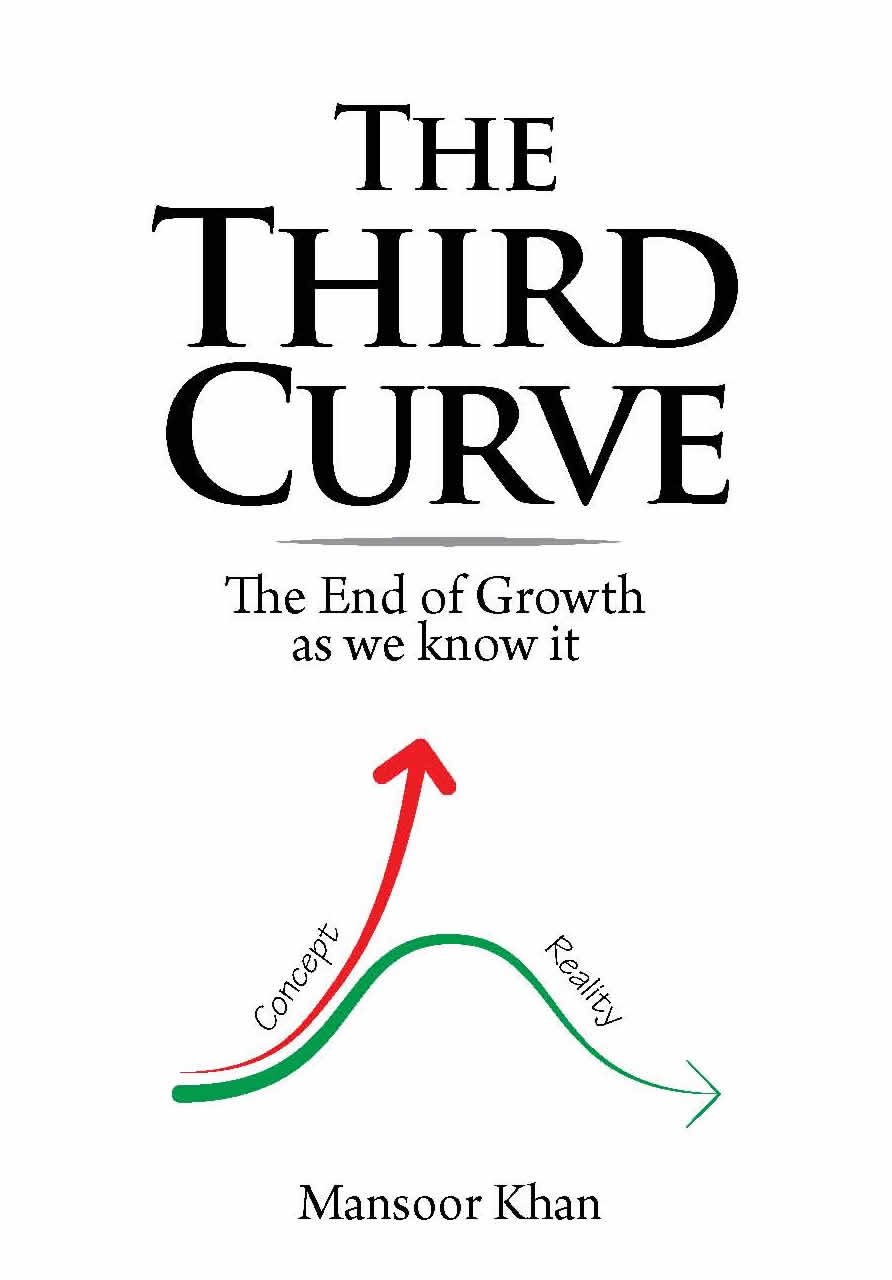
Book Revew: “The Third Curve” – by Mansoor Khan

If you are below 40 years of age then you are likely to face this monstrous problem in your lifetime. If not, no less than certainty our children will surely see the day-with-no-oil.

Daily, we hear thousands of statements about this phenomenon called ‘Growth’. We are now conditioned to believe that growth is a natural reaction of society. When growth becomes our religion, we choose governments, ideas and all notions that support the concept of ‘never-ending growth' then the author shakes our consciousness to portray the sustainability of the concept.
If ‘never-ending-growth’ concept is seen as sustainable the question arises, for how long? Mr Mansoor Khan has tried to provide us the lens to understand the inversion of economic reality. It identifies the root cause of the malady by reminding us of forgotten relationships between money and energy, capital and resources and reality.

Though ‘Oil-Peak’ has been discussed here with great extent but the foundation of this book is laid on the ‘Unsustainable-Concept’ of exponential growth with exhausting natural resources. In spite of using heavy graphs and big numbers, Mr Khan, very aptly used an analogy to understand and realize the depth of the problem.

Part-1 states the story of ‘The Coach and the Runner’. The coach has a concept which he claims can make you the runner, run at the speed of sound in just 18 months.
‘How is that possible’, you wonder.
He explains, ‘Can you run at 10km/hr?”
‘Yes, of course, that is slightly faster than walking’.
The logic game goes further. ‘Then you can run 7% faster at 10.7 km/hr, right?’
‘Sure’, you agree.
‘After three weeks, you can run 7% faster at 12.25 km/hr?’
‘Sure’.

The coach promises that you can run 7% faster than last week every week. In this way, it will take 18 months to break the spead of sound. Awesome!

The coach approached the sponsors and display encouraging charts, supported by descent logic. Picture is rosy so sponsors are ready to pay money and training starts. In phase 1, you ran 7% faster, sponsors are happy, and all is going well as per the plan.

In phase 2, you fail to run faster at same growth then your coach puts you on steroids and you are able to run little faster, say 3% or 4%. Bur in phase 3, you collapse.

Here comes the explanations of the first two curves; the first curve is the exponential curve, that is desired speed (goes to infinity) and second curve is bell-shaped curve which is actual speed (body). The concept (mind and desires) i.e exponential curve goes to infinity, the same way we think about economic growth. We are convinced that our current concept of infinite economic growth will keep the growth as it is. The reality (body and resources) can be seen in bell-shaped curve which has start, rise, peak, downfall and end. All natural resources including oil follow the bell-shaped curve; we started using, increased production, reaches peak, slow down production and finally finishes.


 Our demands from the nature follows the exponential curve, isn’t it?. Can we afford to live without the idea of growth? A big question for all of us.

We are positive people, sorry extremely positive people filled with creativity so we find the alternatives, we think. ‘Oil Peak’ has always been the burning issue since early 90's but the truth of the matter is oil production follow bell-shaped curve. Ever if the peak is shifted, the decline is inevitable. Many of us or our children will face the consequences of oil-depletion.

‘The third Curve’ nicely explains the fragile financial system which sits on the idea of greed and desire of ever-increasing economic growth. When historic money data is blended with oil data then it clearly shows the exponential curve of money that all the governments are producing. The historic oil data follows the half bell-shaped curve. Experts say that we are at the Oil Peak and oil will be produced lesser and lesser in the coming future.

Just because to protect this economic growth the current human generation has compromised everything; Natural Capital (natural resources), Ecological Capital (forests, rivers and animal kingdom), Social Capital (bond of family), Cultural Capital, Spiritual Capital (honesty, trust and peace).

The third part of book check the sustainability of the alternative sources of energy. Here alternative sources are seen as ‘A Mirage of Hope’ which is elaborately explained with graphs and ideas. All alternative sources (like wind, solar or nuclear) and ideas (like technological advancement and energy conservation) have to be viewed in the perspective that it is going to replace the oil, which is the backbone of the current economic model. Alternates have to be very strong to take that place, merely presenting the rosy picture of alternate ideas in some conferences do not serve the purpose.

For the same, the author tested all the ‘Hot Alternatives’ on five technical parameters which are called Energy Rules. These are; Rule #1 Net Energy, Rule #2 Oil Dependency, Rule #3 Energy Density, Rule #4 Scalability and Rule #5 Oil-by-Product.

Unfortunately none of the alternative sources passed the test to replace oil. Let us understand with an example, if we take Wind Energy, it fails Rule#2,4 and 5. Wind energy is intermittent, low density, expensive, oil dependent, has limits of scalability and generates only electricity. It is sorely dependent on Government subsidies for viability. It can never keep the Modern Industrial World running the way it is on oil. Same is with Nuclear energy, it fails Rule# 2 and 5.

There is no escape unless we change the concept of growth. This has been explained in the fourth part of the book which is ‘The Third Curve’. The third curve is called ‘The Eternal Rhythm of the Universe’. It synchronizes with the nature and its resources. It is not a question of how much energy we can find and burn in an illusion of success and progress, but is a question of how much we should.

The third curve of a living earth faithfully follows the rhythm of our primary energy provider, the Sun. Reliably it rises, peaks and ebbs only to rise again. Nothing going to the sky and nothing going to the zero. We are reluctant to accept the truth, the author says that we have two paths; denial or acceptance of Peak Oil.

The part through denial can certainly extend our moment at the top but a chaotic collapse is certain. The path through acceptance can immediately start a soother, longer and managed energy descent, which involves re-alignment of our economic paradigm.

Last and fifth part of the book focuses on ‘Rebuilding a post oil world’. In this modern industrial civilization, the collective belief so far has been ‘big is beautiful, more is good, individualism is prime etc.’ All this led to a particular kind of social structure and lifestyle.

Author urges that we now have to believe personally that ‘small is beautiful, less is good, local is important, community is strength and diversity is paramount.’ This amounts to a huge shift in our cultural perspective. Not easy but then we are not talking about ease, we are talking about what is likely to work in an energy declining world.

The book is very inspiring and captivating. You can certainly digest the heavy stuff with ease as author left no stone unturned to keep its presentation precise. Coloured graphs, clear diagrams and good quality pictures are augmenting the effect of the high quality research work of Mansoor Khan.

By the way, Mansoor Khan is an alumni of IIT Madras, Cornell University, and MIT, Boston. He started his career as film-maker and made his directorial debut with Hindi film ‘Qayamat Se Qayamat Tak’ in 1988. His other famous films are ‘Jo Jeeta Wahi Sikandar’, ‘Josh’ and ‘Akale Hum Akele Tum’. Hope you will enjoy reading this book.

Key Words: False Money, Pseudo-Assets, Financial Jugglary and Proliferation effect.

Tuesday, May 5, 2015

Book Review: PROFILE OF THE PERFECT PERSON: Based on The Bhagavad Gita Chapter II


Author: JAYA ROW
Publisher: JAICO

In an attempt to achieve excellence in all spheres of life we rely on religious or spiritual scriptures which are based on undeniable natural truths. The Bhagavad Gita is more about the proven guidelines to live successfully and happily in modern world than a religious text. “PROFILE OF THE PERFECT PERSON” explores verses 56 to verses 72 of Chapter II which outlines the basis of a perfect person.  Smt. Jaya Row, a commentator of Vedic philosophy, demystifies the versus in common language with perfect analogy and examples.

The Author asks why we are so bored with everything around us. It is because the essential ingredient is missing from our life. Bhagavad Gita is the most important ingredient of life, SALT OF LIFE. Trying to live without Gita teachings is like eating food without salt. The world today is like an enormous ocean with daunting waves. If we wait for the waves to subside we will be waiting forever. Instead we learn to surf them, the experience become enjoyable. In fact the more formidable the waves, the greater the thrill! We need to master the technique of riding the challenges, the world throws at us instead of buckling under pressure. And the first step is knowing ourselves.

Our personality is composed of four entities. The body is our outer layer which receives stimuli from the world and responds to them by way of actions. The mind is the home of emotions and feelings it generates love and hate, creates whims and fancies and function on impulses. Third parts is intellect, which differentiates between pairs of opposites (good or bad, correct or incorrect), it is the abode of rationality, analysis and judgement. Spirit is the fourth entity, referred to as Atman – is your true self. It breathes life into lifeless body, mind and intellect.


The mind is just a flow of thoughts that grabs at instant joy. It is incapable of discerning what is in our long-term interest and what is not. It is the intellect that can set aside the lure of immediate joys and guide us to deferred gratification.


Bhagavad Gita is about tapping the full potential of human being and the source of unlimited happiness. This book elaborates the happiness at 4 levels. Physical level or body level happiness can be achieved by sense-gratification. Our senses (eye, ear, tongue, nose and touch) are attached with their desires and we spend our whole life in satisfying our senses. Are we happy by the satisfying our senses? It is momentary, it is a trap and lowest level of existence. Second level of happiness, which is above the physical level, is emotional level. We have no worth of physical pleasure when we pursue emotional happiness. Strong emotional reasons overpowers the physical conditions. Many sportsmen have proven this in different arenas where emotions played a vital role. Intellectual level drive is the one level above emotional level. If you are driven by an intellectual idea you have access to far greater reserve of energy and vitality than you ever imagined.

The last and highest level of satisfaction is spirit level, the state of realization. When you can touch or access the innermost source then there is no desire left, everything is infinite at this stage.  This is the highest goal of every human being. Moving above the level is the gradual and systematic process which is governed by Yoga.

Chapter II of Bhagavad Gita explains the highest level of perfection in human being. The perfect person is said to be ‘sthitaprajana’ means ‘one established in wisdom’. In Verses 56-59, Lord Krishna expounds on the definition with greater descriptive clarity. Verse 60 is about how the powerful senses attack the mind and lead it astray. In verses 61 to 66 Krishna gives the pivotal role of the intellect. In 67 it says that the mind which has been misled by the senses drags the intellect away. Verse 68 says only the person who has controlled the senses qualifies be a ‘sthitaprajana’.

Second part of the book enlightens the path to be sthitaprajana. A person of steady wisdom is one who totally abandons all desires from the mind which sounds frightening to us. Desire is the function of mind. One can achieve the state of no desire when one has access to his own infinite status, everything else pales into insignificance. When you are captivated by a higher interest your previous desires fade away. Spiritual evolution must be gradual. When you are full of desires you cannot suddenly drop them. In fact you cannot drop desires at all. What you can do is learn to appreciate something of greater values. Something more fulfilling then you are engaged right now. Fear and anger are aberrations of desire. When you are free from desire you are automatically free from fear and anger. The Gita gives us the formula of happiness.

Happiness = Number of Desires Actualized/Number of Desires Harboured

The happiness quotient can be increased either by increasing the number of achievements or decrease in the number of unfulfilled desires.

The language is very simple, precise and honest. It is meant to be thought-provoking and inspiring. The whole book is sprinkled with particle ideas and is exhaustive on the subject.

Saturday, November 8, 2014

Book Review: Power Of The Best

Authors: Peter Brown and John Hughes
Publisher: Portfolio Penguin

“Canada’s ‘Best Managed Companies’ program began in early 1990’s, when plants closing and job losses were the order of the day” writes John Hughes and Peter Brown, authors of this book. Peter Brown National Co-Leader, Best Managed at Deloitte and John Hughes was leader in Greater Toronto Growth Enterprise practice for Deloitte.

Tough times crushes the majority but paves the path for the ‘real toughs’ to show their character and stand still and move forward. Best Managed Companies program is sponsored by Deloitte, the Canadian Imperial Bank of Commerce (CIBC), the National Post and Queen’s school of Business. The program aims to build the network of exceptional Canadian businesses so they could help one another succeed. Candidates are evaluated each year on how they address key challenges which comes under: Strategy, Capability & Commitment.

Peter Brown & John Hughes’s first book ‘Building the Best’ was focused on growth, strategy, capability and commitment. Power Of The Best deals with twelve themes, explained in twelve chapters, the authors have seen over the past twenty years.

Strategies are not aliens to the organization but some successful companies designs them not just the better way but creates the ‘Blue Ocean’ (Blue Ocean states above the competition) out of it, as shown by Great Western Breweries in chapter one titled ‘Strategy: Brewing Up A Winning Formula For Marketplace Success. The strategic plans do not always work out as planned. Companies that embark on them need to be alert and nimble enough to recognize when market conditions have changed. It’s the responsibility of the leadership to convey the need for the commitment and to provide the tools and structures necessary to achieve it.

The second chapter deals with the innovative concept of leadership. Leadership in business is seen as a purview of individuals, charismatic personalities leading thousands of people. Leadership in Canada’s Best Managed companies is dedicated to minimizing hierarchy even to the inverting pyramid (often called Collective Leadership) so that employees understood they have the power to lead without waiting senior management to show the way. The author explains, economic uncertainties, new technology, greater regulatory scrutiny and global competition are demanding more responsive operations. It’s more gratifying and more profitable to lead a group of collaborators rather than the group of followers. The companies in this chapter vary enormously in size, but trier essential leadership philosophy is the same. Leaders do more than issue orders. They need to be supported by talent in decision and that’s where ‘Collective Leadership’ lies.

You can’t step into reading the third chapter without getting impressed with the title of the chapter, Branding and Marketing: Making the product an experience, not a thing. A brand is more than a logo, a trademark, or a bottle of pop on a supermarket shelf, speaks author. A brand is not something that can be papered over by an organization with clever slogans or advertising. It reflects the authentic value of the enterprise to the clients. The clients perception of brand must align with the company’s self-perception if the brand is to have true value.  This chapter explores the brand strategy of three B2C (business to customer) companies and one B2B (Business to Business) company. Fountain Tire, Goodlife Fitness and Harley Davidson are associated directly with their customers so they can  check the quality of experience of their customer at different levels. “We draw a direct line between customer experience & profitability”, Harley Davidson says. While operating B2C or B2B many of its strategies for marketing are different but essential theories of building, maintaining & marketing a strong brand is no different.

The chapters like funding growth gives an insight into the innovative solution to feed fund requirements of the company’s unique business model of OMERS private equity bridged the gap between pension fund safe investment requirements and fund-deficit organizations.

Mergers & Acquisitions (M&As) are required to increase capabilities, capacities and to expand in the new areas of businesses. Niagara Group, providing mechanical contracting services focused on plumbing and piping, acquires Golan Mechanical to provide total mechanical package. Acquisitions are not the matters of spreadsheets but a lot about integrating the cultures. Good culture match is important. Edmonton-based Supreme Group shared ‘2011 Engineering Award’ from Canadian Institute of Steel Construction (CISC) of ‘The Bow’, 58-storey tower. Supreme Group has not only relied on acquisitions to increase its competitiveness, it undertook many projects through Joint-Ventures.

When somebody speaks of innovation in business we invariable think about technology, hardware, patents and new product breakthrough. Seventh chapter not only talks about the companies that have excelled through the introduction of innovative products but also bring new ideas to market that require as much innovation as innovation themselves.

Burnbrae Farms Ltd. is a remarkable story of innovation which once was family business but today it presides over largest integrated supplies in Canada, selling over 35% of the shell eggs and over 80% of retail liquid egg products. More than 300 egg producers reach the market through Burnbrae’s grading station. Cactus Club has changed the casual dining experience and it has nothing to do with engineering breakthrough. Technology can be an important aspect of innovation but it remains a subject on its own, believes author.

To be the best is to do the best and that’s where sustainability comes. Sustainability too often is seen as a corporate luxury, a feel-good option located well beyond the business plan. But the president of  DIRTT (Do It Right This Time) says ‘If being green or sustainable costs more money, then that solution is not sustainable itself’. DIRTT founder, Mogens Smed, earned 2010 Product Prize from American Society of Interior Design for his contribution to the advancement of desing. Such out-of-the-box approach towards sustainability made DIRTT to be listed in Best Managed list. Steam Whistle with Bullfrog Power powered its Roundhouse brewery in Toronto with zero carbon emission, drawing electricity only from wind farms and low impact hydro generation. For many companies that are embracing sustainability, a “green” ethos is good business because customers respond positively to it.

All local and global brands are switching gears to attract and retain talent, suggests chapter ten, which depicts the story of four of Best Managed companies that faced unique challenges in attracting and retaining workforce talent and have applied their own solution to great effect. Great Little Box company’s talent retaining strategy comes down to not how to attract but who to attract. And then throwing plenty of social events as employees spent their maximum awaking time with their colleagues. A broad basket of compensation, fresh fruit every day, BMI (Body-Mass-Index) contest, getting paid to quit smoking, 24X7 fitness centre where you can bring a friend on weekends, own vegetable garden, take part in golf tournament and so on won’t make anybody to think about changing the company. Another interesting example is form Brock Solution from Ontario. The company embraces ‘Lattice Model’ in which hierarchy into different assignments and challenges, developing new skill sets along the way. Instead of strict vertical model of increasing seniority, a lattice environment seeks to deliver growth for an employee with multi-directional movement. One project, an employee might be a technical lead and on another that person might be a project manager.

The companies profiling inspire all entrepreneurs who resolve to turn challenges into opportunities. The book talks about the success stories of the scores of companies and many Canadian Business Leaders that make it an indispensable book-must-read for all entrepreneurs, business leaders and those you aspires to become business leaders.  

Monday, February 24, 2014

Book Review: Talent Is Overrated: What Really Separates World-Class Performers from Everybody Else

Author: Geoff Colvin
Publisher: The Penguin Group
MyRating: 5/5

‘Talent Is Overrated’ is not another book in the volumes of ‘Performance Improvement Tips’ that fills you with motivation while reading and then pushes you into the black-hole of repentance when facing real life situations.

It would not be exaggeration if I call this book as ‘research paper’ aiming to present the available facts in easiest words possible. This book is an inside story of all the great achievers of the world; be it an organization or an individual.

The world often mesmerizes with the great shots of Tiger Woods in golf arena. They praises it as god’s gift or hard work without realizing that fact that his father made him to sit and watch him hitting shots hours after hours when he was only seven months old. The author claims that there is nothing like ‘natural talent’ or ‘hard work’ that makes any performer as best performer but it is the ‘Deliberate Practice’.

The author, Geoff Colvin, is the senior editor at Fortune. He is the lead moderator for the Fortune Global Forum and he co-anchored ‘Wall Street Week’ on PBS for three years. According to the author, both the hard work and natural talent camps are wrong. What really makes all the difference is a highly specific kind of effort that few of us pursue when we are practicing golf, pianos or stockpiling. This book shares the secret of extraordinary performances and how to apply these principles to our lives and work.

The book is divided into eleven chapters breaking the all-prevailing myths. And explain the steps to deliberate practice. I fail to find any assertion in the book that is not supported by any research and example. Colvin explains deliberate practice is a large concept. It’s about: what exactly need to be presented? Precisely how? Which specific skills or other assets must be acquired?

Deliberate practice is very hard and in most cases it is ‘not inherently enjoyable’, then why do some people put themselves through it day after day for decades, while most do not? Where does the necessary passion come from? The question has been answered in the last chapter ‘Where Does the Passion Come From?’

The passion to put oneself into the deliberate practice comes from intrinsic motivation. The intrinsically motivated state is conducive to creativity, whereas extrinsically motivated state is detrimental. To explain this author has used may illustrations, one of them is: ‘For most of the mathematicians, the joy of discovering a new way of solving problem was more important than a high test score or receiving good grade’.

But not all the time extrinsic motivations that do not work. It has been observed in many cases that extrinsic motivation stimulated intrinsic motivation. Like, “if you don’t do your piano practice we’ll sell the piano” or “If you do not go to swimming practice we’ll take you off the team”. If the child truly didn't care about the piano or swimming these threat wouldn't work but if he cares about them these threat will work for him.

Chapter five and six explains about what deliberate practice is and isn't and how deliberate practice works. How can we apply it in our lives and in organizations is addressed by section seven and eight in the book. There are three models of practice; the music model, the chess model and the sports model which can be applied in different arenas of practice.

No question is left unanswered by the end of this book. It is not that book that is entirely read in one deep breath. It is serious intervention in the personal and organizational performance set-up. The book is written in easy and racy (exciting and interesting) style. I recommend this book to everyone who struggled to perform well and to those who are in the field of training and development. 

Wednesday, February 5, 2014

Book Review: The Heart of Change

Author: John P. Kotter
Publisher: Harvard Business Review Press
MyRating: 4.8/5

Significantly changing the behavior of a single person can be exceptionally difficult task. Changing 101, or 10,001 people can be a herculean task. Yet organizations that are leaping into the future succeed at doing just that.

Turbulence will never cease but winning organizations will continue to deal with this fact by following certain steps of transformation. The transformation means the adoption of new technologies, major strategic shifts, process engineering, mergers and acquisitions, restructuring into different sorts of business units, attempts to significantly improve innovation and cultural change. To understand why some organizations are leaping into the future more successfully than others, one need to see the flow if effective large-scale change efforts. And this flow is often a set of eight steps that few people handle well.


The story of ‘The Heart of Change’ starts with the Author’s first book ‘Leading Change’. Leading Change describes the eight steps people follow to handle large-scale change for any transformation in the organization. According to the author, a few questions were unanswered, especially about how more specifically achieved what was described in that book. John Kotter, author of this book, got the invitation from Deloitte Consulting to work on a follow-up project by massive interviewing and to collect stories that could help people me deeply understanding the eight-step formula. The Heart of Change digs out the core problem people face in all of those steps and to successfully deal with that problem.

John Kotter is internationally regarded as the foremost authority on the topic of leadership and change. Kotter is the Konosuke Matsushita professor of Leadership, Emeritus at the Harvard Business School and a graduate of MIT and Harvard. Most recently Kotter was involved in the creation and co-founding of Kotter International. He has authored eighteen books, twelve of them are bestsellers.

This book is extending the scope of eight-step process by explaining how they can be implemented using various case-studies from different industries. Kotter’s main finding is that the core of matter is always about changing the behavior of people and behavior change happens in highly successful situations mostly by speaking to people’s feelings. So, See-Feel-Change mechanism is more powerful than Analyse-Think-Change, asserts Kotter. The pattern of Seeing-Feeling-Changing is applied in all steps to steer the emotions of the people.  

The book is divided into eight chapters, each explaining the proceeding steps of change, supported by convincing conclusion. The book has been written in easy and racy style, full of zest and strong quality that would make even a lay reader to sit-up and think.

The first step contributes to the idea of creating urgency among relevant people. Too much complacency, fear, anger, or all three can undermine change. A sense of urgency gets people off the couch and ready to move which is succinctly explained though ‘The Videotape of the Angry Customer’, a case. When employees watch the video of angry customer, most employee were surprised, some became fearful, many find false pride dropping a notch and a sense of urgency growing within them and they start listening to the customer and management. Now they talked about the need of change. When urgency turned up, in step two, the most successful change agents pull together a guiding team with the credibility, skills, connections, reputations, and formal authority required to provide change leadership. This group learns to operate with trust and emotional commitment. In the best cases, the guiding team creates sensible, clear, simple uplifting visions and set of strategies, this comes under step three. Detailed plans and budgets, although necessary, are insufficient in large-scale change. A vision shows an end state where all the plans and strategies will eventually take you.

Step four narrates the importance Communication of the vision and strategy, which is simple, heartfelt messages sent through many unclogged channels. The goal is to induce understanding, develop a gut-level commitment, and liberate more energy from a critical mass of people. Step five is all about removing the key obstacles that stop people from acting on the vision. People are Empowered with information and self-confidence to work for the vision. In less successful situations, people are often left to fend for themselves despite impediments all around. So frustration grows, and change is undermined. Obstacles in the form of system barrier, barriers of the mind and information barrier disempower people. The author cautions trying to remove all the barriers at once.

The most interesting and important step is short-term wins, which is step # six. The wins are critical. They provide credibility, resources, and momentum to the overall effort. Without sufficient wins that are visible, timely, unambiguous, and meaningful to others, change efforts inevitably run into serious problems. Initial wins consolidate early changes and that should not declare victory prematurely, warns author in chapter seven. The most common problem at this stage is change efforts is sagging urgency. Success becomes an albatross. “We’ve won”, people say and you have problems reminiscent of those in step one. Finally, step eight concludes the change process my making the change stick. Change leader make change stick by nurturing a new culture. A new change - develops through consistency of successful action over a sufficient period of time. Appropriate promotions, skillful new employee orientation, and events that engage the emotions can make a big difference.

Because the world is complex, some cases do not rigidly follow the eight step flow, but the eight steps are basic pattern associated with significant useful change. This book is not a textbook of management school but a handbook for professional manager. It is the outcome of industrious research and insightful results to make any large-scale-change a real and long term success. 

Saturday, January 18, 2014

Book Review: SUPERPOWER? The Amazing Race Between China’s Hare and India’s Tortoise


Author: Raghav Bahl
Publisher: Penguin Group
MyRating: 4.5/5

China’s growth story has always been the fuel of discussion for opposition parties in India and for everyone who chooses to criticize India’s way of growth. Undoubtedly, China’s hare is far away than Indian tortoise when we compare the gigantic Chinese GDP with India’s GDP. But comparing two countries on the basis of only one parameter i.e. economic fundamentals is not quite apt when we are comparing these contenders for the next superpower. The emergence of these two potential neighboring superpowers came out from the ironic different paths of history explains Raghav Bahl, the author of this book; “SUPER POWER? The Amazing Race Between China’s Hare and India’s Tortoise

Raghav Bahl is the founder and Editor-in-Chief of Network 18. He was hailed as the Global Leader of Tomorrow by the World Economic Forum and selected by Ernest & Young as Entrepreneur of the year for Business Transformation in 2007. The book starts with the notion of doubt that prevailed long among the western countries about the survival of India as the world’s largest democracy. But with the existence of universal adult franchise (It is the right of all adult citizens to vote without any discrimination), equal fundamental rights, a daringly free press, a genuinely autonomous judiciary, a bustling entertainment and information society, a strong English-speaking middle class, a high quality technological and education infrastructure and the culture of liberal thoughts; the west could not discount the contender-ship of India, like China, as a future super power.

The book is comparing India and China on five parameters which are explained in five parts of the book; the race begins, geo-politics, entrepreneurs, consumers and English speakers, urbanization and infrastructure and social infrastructure. In the epilogue section, the author bets fifty-fifty on India and China stating the reasons for not underestimating India’s potential of growth and overestimating China’s capabilities. The book ends with answering the questions related with the future of India and China, which is supported by the experience of the author, not with any forecasting model. It makes this book more comprehensible and easy-to-read for anyone who wants to know the history and growth model of both the countries, without any technicality.

Both India and China were giants in the seventeenth and eighteenth century and accounted for 50 per cent of world GDP in 1600. But two hundred years of colonial domination shrunk their economies and political space on the globe. The British describe their rule as one which ‘civilized’ India whereas China’s colonial history was far more turbulent several rulers without a similar ‘institutional osmosis’. India attained freedom in 1947 and Mao Zedong founded the People’s Republic of China at a massive rally in Beijing. India became a parliamentary democracy and China became a totalitarian state. Till 1978, both the hare and the tortoise were at the starting line but hare had started it reforms at this time while tortoise didn’t realize this till 1991, a decade later after China stared to leap in the race. Nearly two and a half decades after hare has become a $5.9 trillion gorilla while tortoise is a 1.6 trillion cub.

The robustness of the two models was tested in 2008 during Leyman Brothers collapse. When whole world got panic India’s stock market reacted the other way allowed its investor to short the stocks while China, whose stock markets had not even been introduced the concept until then, chose to go ahead with a trial experiment in short selling just a month later.

When religion is the main force behind geopolitics played by America, Britain, Saudi Arabia, Iran and other countries, it is clearly not driving the geopolitical reflexes of India or China. But economic ambition is. Raghav Bahl equalizes both India and China on geo-political parameter. I think, he should also mention the effect of China’s ‘veto’ power in United Nations in world’s geopolitics.

When George Soros (a well-known investor) visited India in 2006, he said in his interview that the one word that makes India far ahead of China is ‘Entrepreneurship’. China has over 2,000 listed companies and more than 80 percent of these are state-owned and India has over 6,000 listed companies and over 95 percent are privately owned. The demography of India is far more conducive to the India’s growth as compare to China. By 2020, US could be short of 17 million people of working age, China 10 million, Japan 9 million and Russia 6 million. Only India will have a surplus of 47 million people in the working age. If India can harness this population then it could become the job exchange of the world. But if it fails to do that, India could become the job graveyard, explains Raghav Bahl.

The sector where China made progress by leaps and bounce is urbanization and infrastructure. China has become the standard for India can be seen in the PM’s statement when he wishes to transform Mumbai as the Shinghai of India. The author keenly studied the basis of this difference which lies in the approach of both the governments. While Chinese mayors may be accused of overreach, Indian Municipal leaders lacks ambition. China has added 20,000 km of railways tracks in last two decades and India done a 860 km in same period. China’s rail investment was $133 billion in 2010, fourteen times that of Indian railways. China has 18,000 km of coastline against India’s 7,500 km. China also has 1300 ports against India’s 200 making China a bigger seafaring nation. In 2010 China has 960 GW of installed capacity, five times more than India.

The race between China’s hare and Indian tortoise will depend on the China’s not-yet-fully tested model of ‘escape velocity’ and India’s classical and sustainable model of development. When China is investing nearly half of its GDP in its factories and creating infrastructure, India is struggling to hit the meagre targets in investment. Paul Krugman, a Noble Laureate, explains that the answer will not be quite as simple as who is investing more and growing faster today but a lot will depend on who has superior innovation? Who has more entrepreneurship savvy? Who is expanding in intensely competitive conditions?

The growth potentials of the two countries are measured on tangible and intangible abilities of India and China but, I feel, Raghav Bahl should also have covered the available natural resources in both the countries and their approach in acquiring the world’s resources. The growth model of United States resides on its huge natural resource base and their strategies in acquiring resources in other parts of the world. If any country wants to achieve and maintain double digit or close to double digit growth rate then the sustainability will largely depends on the fulfillment of its energy requirements.

 The book has been praised by Anand Mahindra (VC & MD, Mahindra and Mahindra), N.R Naraina Murthy (Chairman, Infosys), Mukesh Ambani (Chairman and MD, Reliance Industries), Bimal Jalan (former governor RBI), K.V Kamath (Chairman, ICICI) and many more authors, policy makers and entrepreneurs. I found the complements from Mr. N.R Naraina Murthy are most apt in the description of this book. He says ‘In his inimitable way, Raghav Bahl has painted very insightful and highly data-rich perspective on the history and potential of India and China. His powerful story-telling, backed with analytical research………..’.

The author disclaims that he is not writing this book as academician or economist or policy maker so he recommends reading this book as a work of instruct, intuition and his experience. But I didn’t find any arguments or statement, given in the book, that is not supported by any data or available fact. 

Sunday, December 15, 2013

Book Review: Numbersense


Author: Kaiser Fung
Publisher: Mcgraw Hill Education
MyRating: 4/5

Numbersense: How to Use Big Data to Your Advantage’ is not such type of book that we often grab to read. Especially when the book is published by Mcgraw Hill Education, that reminds us of our old college days, make even more difficult to hold the book. When we were told that we are born with five senses (seeing, hearing, touch, taste and smelling) and suddenly somebody says about the other sense (number sense), it is difficult to ignore the author’s intention.

Kaiser Fung, who is a professor at New York University teaches practical statistics, is the author of this book who also wrote ‘Numbers Rule the World’. He claims that Numbersense gives you the insight how big data interpretations works and how it too often doesn’t work.

Numbersense is not another book of statistics or data analysis that tell about how to manage, represent and analyze data but it shows, using many examples, how to develop the sense to recognize ‘misleading behaviour’ of big data. Number sense is the noise in your head when you see big data or bad analysis. It is the desire and persistence to get close to the truth.

The book is divided into four sections; social data, marketing data, economic data and sporting data. In these four sections author has shown that how the data has been used to manipulate the results in the society.

Measuring anything subjective like; aptitude of students, quality of teacher, employee performance etc always carries a pinch of doubt as they don’t carry intrinsic value. How much amount of fat in the body can be find out using several diagnostic methods but how obese a person is a matter of perception supporting by specific measuring tool. As shown in the book, the percentage of obese population gets change when DXA (Dual-energy X-ray absorptiometry) is used in place of BMI (Body-Mass Index).

The most elaborative and interesting section is ‘marketing data’ section which unveils the strategies and business model of Groupon, an online business that sells deals. One set of data favours Groupon in benefiting the local merchants whereas another set of data claims that Groupon is hurting the business of local merchants. When such confusion arises then there comes number sense which differentiates the objectives of data. Another element of Groupon under study in the book is ‘Target market’. Groupon communicates with its clients through Emails, which they send to their target market. The success rate of their targeting model is 0.06% ie for every 10000 emails they get deals from 6 clients. Many targeting strategies are recommended on the basis of different sets of data.

The author raises questions on how economic data is far away from the truth. The inflation and employment data are adjusted using the adjustment factor and assumptions which make it hard-to-believe for any data analyst. In the epilogue of this book, the author expects from the readers that they won’t take data at its face value ever again and they look it under the hood.

In all the sections of the book the author comprehensively explained with examples that what is shown is not always true. The examples are quite apt with the topics and easily understood as they are explained in simple language without using the statistical jargons. It’s a good-read for those who are interested in behind-the-scene-theories and like to crunch numbers to find out the truth. But obviously it’s not a casual read.

Wednesday, May 15, 2013

Book Review: Rich Dad’s Conspiracy Of The Rich

Author: Robert Kiyosaki
Publisher: Business Plus
Rating: (3.0/5)

RICH DAD’S CONSPIRACY OF THE RICH THE 8 NEW RULES OF MONEY is another book from the Rich Dad Poor Dad series of Robert T Kiyosaki. It shares author’s view of global economics and explores why people are finding themselves challenged during turbulent times. He challenged the world’s known principles of investing which talks about mutual funds and retirement planning.

During global slowdown it was the conspiracy of the Rich dad (rich people) to take money from the lower class to compensate for their mistakes. The authos says that the money which was taken from public by the rich banks in the form stimulus, TARP were not disclosed to them. Instead it was discreetly used by them to cover their bleeding balance sheet,and not to save the economy.

He says, it is not the financial experts or government or elected leaders who will decide more secure financial future but one has to make themselves their financial decisions through financial education that is studying the relationship between tax, debt, inflation and retirement.

Debt is not as bad as we think about it but it need to be used properly. There are two types of debt; good debt and bad debt. The bad debt takes money out of your pocket and good money puts money in your pocket. Good debt increase positive cash flow and put money in your pocket.

The author repeated a number of things number of times and explains the history of money in non-technical language. He seems correct by saying dollar is now no more money but only a currency. But still there are a number of things that need more explanations. For example, cash flow not the capital gains should be the game, but common person fails to understand that in stock market cash flow is in the form of dividends only and is meager so purchasing stock only for dividends is not justified.

Money is education, financial education to be very precise. Roberts puts more onuses on the individual to be rich and financial IQ or financial education is the only way. The education  system does not support the financial lessons leads to poor financial education to the people. Financial education is for the rich only.

Saturday, April 20, 2013

Book Review: If God was a Banker

Author: Ravi Subramaniam
Publisher: Rupa
Rating: (2.8/5)

'If The God was a Banker" is a story from Ravi Subramaniam which not only speaks about the inside story from banking industry but also reveals the dirty story of the corporate world.

It is a story of two young management IIM's graduate with nothing similar in family background and temperament. Both took different routes to success, Sundeep was aggressive and go-getter and Swami was mature and sensible with high regards of good old ethics. 

There are other major characters in the book, including Natasha - Sundeep’s wife, Kalpana - Swami’s wife, and Aditya Rao, who is a friend, philosopher and guide to the two main characters.

Both rise quickly up the corporate ladder, but Sundeep’s career picks up very soon. His willingness to do anything to better his career brings him in contact with several unscrupulous characters. At one point of time, his life seems to be on the fast track - he gets promoted very soon, and he enjoys the company of many beautiful women, despite being married.

Sundeep's fraudulence is exposed during an audit, he gets discredited for all his doings and Swami is acknowledged as the top performer and  indispensable contributor in the organization.

The author portrays in crisp details, office politics, sexual relationships in office spaces, aggressive competitions within the company, and the frauds and manipulations that are part of the corporate world, in this book.

He used his long experience of banking industry and writes in a very simple language that is understood by everybody. The story is very predictive and does not creates any curiosity to read further.